


For my Sunday Reflections I reconsider the art of breaking away—the moment an artist chooses to step outside the familiar and follow their own path. It is something I have addressed before, yet time has added something more.
What Came Before
Every era has its pioneers, those who redefine the game or refuse to play it at all. Yet not all art is about revolution. Sometimes, it is about the quiet act of making, of shaping something meaningful for yourself. Whether you carve a new way forward or build upon what’s come before, I believe clarity of intention is what defines each artist.
Historically, art is often an act of defiance. Many defining movements emerged because a group—or a singular artist—stood up and declared, "I no longer want to play this game."
Some followed their instincts toward their singularity, often at great personal cost, unrecognized and unrewarded in their lifetimes. In spite of academic norms, Van Gogh painted his potato eaters. Instead of adhering to Realism, Cézanne painted his apples—his way. Picasso and Dalí used their formal training to move beyond academic convention. Rauschenberg refused to keep art separate from life. Bacon violated both pictorial and social decorum. Duchamp and Warhol? They didn’t just reject the game—they rewrote it entirely.
For every period of many, history elevates only a few as its defining figures—those it treats asThe One. These may be the ones we see in museums, but art is not just about museum walls.
Each generation inherits the work of those who came before it, learning from the singular voices shaping art’s evolution. Yet this inheritance is both a gift and a challenge; a blessing and a curse. The work has already been done, the boundaries already pushed. The question is no longer what was created but how it was arrived at—and where each artist took it from there. This is what later distinguishes them.
As we stand at the edge of another creative revolution, the question remains: Which artists working now will history distinguish—and why?
Art As Challenge
Today artists exist in a landscape unlike any before. Technology, social media and an increasingly complex art market have made it both easier and harder to break away. The tools are abundant, the platforms endless, yet the noise can be deafening. How does one create singularity when the world is flooded with images, when algorithms dictate visibility, when artistic value seems at times reduced to engagement metrics?
Art has always adapted. The Impressionists painted outside because of new pigments in tubes. The Surrealists responded to the new landscape of Freud and dreams. Warhol wielded the power of mass production and media prevalent in his day like a weapon. Today, new tools are emerging—AI, blockchain authentication, digital sculpting, generative coding, augmented reality. New hybrid mediums defy categorization.
So if you seek to number among them, ask yourself: What makes your execution singular? How are you using—or refusing—your tools differently? How are you offering something beyond what has already been done? The choice is threefold: Add to the dialogue of art. Subtract from it. Or reject it altogether. The artist’s challenge is not just whether to resist or embrace these tools. At the same time, we must also ask, “How do they serve my vision?”
The tools themselves are neutral, they do not determine artistic meaning on their own. AI can assist, but so can a handmade brush. NFTs may document token ownership or provenance, but they do not change the essence of creation. A viral post can amplify, but it does not define meaning. The challenge is in the intention. How will you use what is available? How will you transform it? Or, will you reject it entirely and carve something by hand, retreat into raw materials, rebel against the digital tide?
The Power of Daily Practice
Not everyone is The One, which is absolutely okay.
For every artist granted Warhol’s “Fifteen minutes of fame,” there are thousands of artists making a living, honing their craft, expressing their voices in ways which may never hang in a museum—but this doesn’t make their work any less valuable. Some artists work for the world, others work for themselves. Some paint because they must, write because they need to, sculpt because their hands demand it.
Living Art Meaningfully does not mean chasing immortality. It means integrating creativity into life—daily, meaningfully, sustainably. It means making art for art’s sake, for self-growth, for healing, for joy, for connection, for a personal legacy without requiring external validation.
Your artistic path is yours alone. You do not have to be a revolutionary to be a creator. You do not have to be remembered by history to leave a lasting impact on your own world.
As you stand at your canvas, at your keyboard, in your studio, at your digital interface—ask yourself:
What do I want to say?
How do I want to say it?
What do I want to add, subtract, or reject?
How do I define my own artistic success?
Not all artists will be The One. Yet any artist—when creating with intention—is part of the great dialogue. This is what really matters.
So, break away. Or don’t. Whatever you do—do it deliberately.
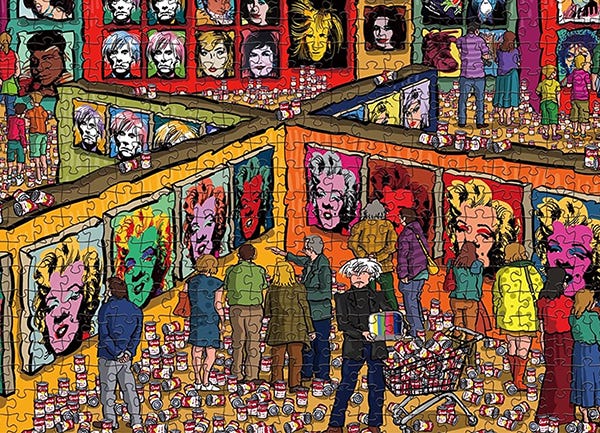
Fun Warhol Puzzle image for today, and actual puzzle!
If you enjoy my Sunday Reflections, consider fueling my next!
Inspirations and Thoughtful Readings—
On Artistic Breakthroughs & Singular Vision
The Shape of Content – Ben Shahn
The Creative Act: A Way of Being – Rick Rubin
What It Is – Lynda Barry
Ways of Seeing – John Berger
Man and His Symbols – Carl Jung
On Defying Convention & Finding Voice
Letters to a Young Poet – Rainer Maria Rilke
Art & Fear: Observations on the Perils (and Rewards) of Artmaking – David Bayles & Ted Orland
Why Are We ‘Artists’?: 100 World Art Manifestos – Jessica Lack
Concerning the Spiritual in Art – Wassily Kandinsky
The Lives of the Artists – Giorgio Vasari
On Art in the Age of Technology & Changing Markets
The Death of the Artist: How Creators Are Struggling to Survive in the Age of Billionaires and Big Tech – William Deresiewicz
Art in the Age of Mass Media – John A. Walker
The Work of Art in the Age of Mechanical Reproduction – Walter Benjamin
Steal Like an Artist: 10 Things Nobody Told You About Being Creative – Austin Kleon